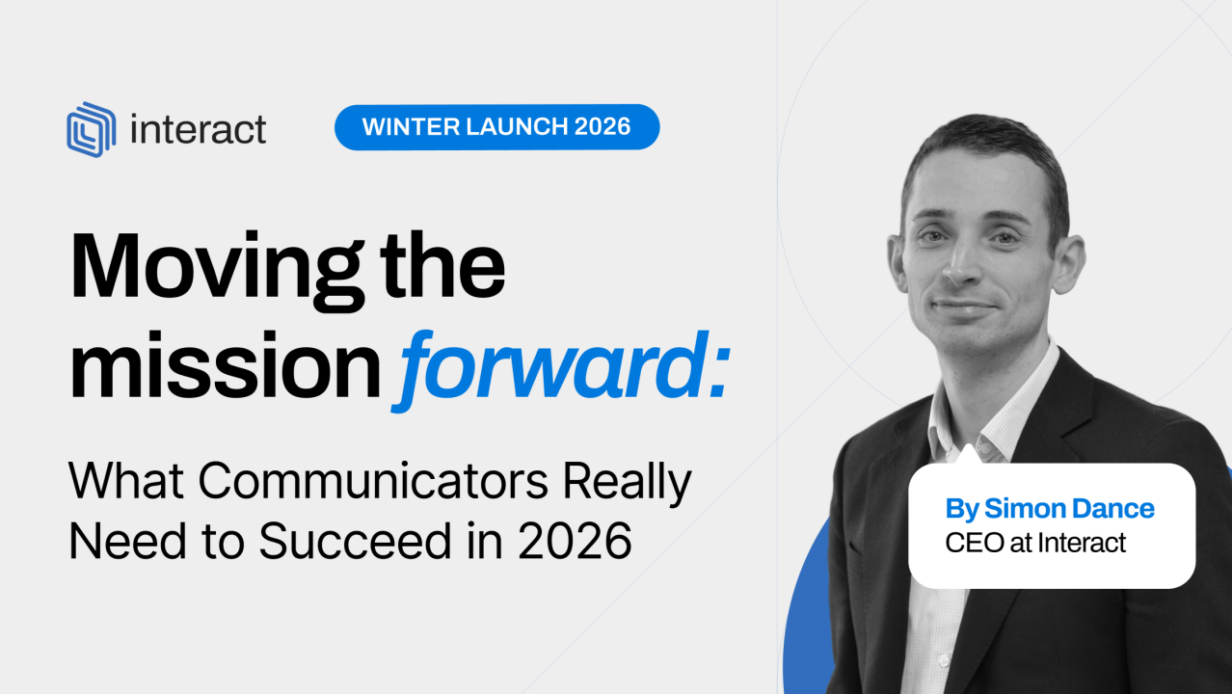
Moving the Mission Forward: What Communicators Really Need to Succeed in 2026

Internal comms is often misunderstood as a support function. It’s seen as a ‘nice to have,’ something that sits outside of the “real work” of the business. But we all know the truth: when communication breaks down, everything else does too. While it may not happen immediately, eventually the breakdown in communication impacts the bottom line. It slowly turns up in higher turnover, stalled projects, and eroded trust in leadership.
At the same time, the headwinds facing IC professionals continue to intensify. In 2026, most teams are still being asked to deliver more with fewer resources. They’re also trying to absorb the tectonic shift that AI has introduced into everyday work.
What the industry gets wrong:
In the mad rush to “adopt AI,” many organisations are putting AI before the horse. That’s to say, implementing tools without first understanding the problems they should solve. In my last post, I wrote about the importance of identifying those real business problems before reaching for solutions. This post is the natural continuation of that idea.
At Interact Software, we’ve spent the start of this year revisiting what communicators truly need to succeed.
Through customer conversations, industry research, and our own product philosophy, we’ve narrowed the opportunity into three clear outcomes. These aren’t product features — they’re the business results internal comms must influence by improving the day-to-day employee experience. Every investment we make ladders up to these outcomes.
In 2026, communicators need to:
- Shift from engagement metrics to business outcomes
- Reduce busy work and remove friction
- Minimise wasted time and replicate what works at scale
Here’s where AI becomes genuinely useful.
1. Shifting from engagement metrics to business outcomes
Most communicators didn’t get into the business because of a passion for spreadsheets. But data is still fundamental. Instead of spending countless hours in a BI tool, AI can connect comms activity to real business results through the prompting of curious, non-technical, professionals. It can show how campaigns influenced a reduction in turnover, improved safety, or helped speed up average onboarding times. By analysing patterns humans would never catch, it turns scattered data into meaningful stories IC professionals can bring to any meeting. This is alignment in action for internal communicators.
2. Reducing busy work and removing friction
AI is the antidote to the operational clutter we’ve all gone blind to. Just as you stop noticing the pile of mail on the kitchen counter, digital workplace clutter quietly drains your team’s mental load every single day. AI can step in as the organiser to clear noise, reduce context switching, and keep people on task. It can assemble prioritised task lists, answer routine employee questions without forcing them to dig through content, and even moderate comments or flag issues before they escalate. It brings a level of self-service that wasn’t possible just a few short years ago. Now, work that used to steal 15 or 30 minutes at a time (across innumerable employees) is now handled by agents. That returns hours of focus back to communicators and the employees they support.
3. Minimising wasted time and scaling what works
Organisations lose more time than they realise. Every transformation (a new system, a reorg, an acquisition, a policy change) creates a productivity dip. People pause. They search. They ask colleagues. They stop, start again, and lose momentum. When you multiply that across thousands of employees, all those “micro‑moments” become real, measurable drags on performance.
AI gives internal communicators the power to reverse that pattern and deliver the knowledge employees need. Instead of every team reinventing the wheel, communicators can identify what’s working well and amplify it. They can use deep personalisation to surface the right content for the right employee, create faster onboarding paths with tailored experiences, or use recognition and agentic AI to elevate big wins. And with emerging intelligent capabilities that coordinate messaging and eliminate manual effort, communicators can finally replace those lost “micro‑moments” with clarity, momentum, and repeatable success.
These aren’t abstract possibilities; they’re the very challenges we’re building Interact to solve.
Turning These Outcomes into Reality
As the role of communications expands from messaging to measurable impact, the tools must evolve alongside it and be proven to solve real business challenges. Interact’s Winter Launch, which was announced today, is a step forward along this continued journey. It gives communicators not just more features, but greater leverage: the ability to connect their work to outcomes, remove digital friction from employees’ daily lives, and provide opportunities to scale what works across the organisation.
These principles will continue to shape our roadmap in the coming year, and we look forward to introducing new features that help orgs move their missions forward.
Read more about our Winter Launch here.
You Might Also Like
 Blog
Blog AI Search optimization tools: why the frontline gains most
AI Search optimization tools mainly help knowledge workers, and rising search volume proves this – that’s the conventional wisdom right now. But Interact’s proprietary…
 Blog
Blog The enterprise AI governance gap: Why so much AI isn’t enterprise-ready
Enterprise AI governance isn’t keeping pace with AI adoption. Organizations are deploying AI tools at speed, and HR, IT, comms, and senior leaders are discovering that the technology they…

 Blog
Blog Building AI that actually works for Internal Comms
There’s a question I keep hearing from IC and HR leaders, and it’s changed noticeably over the past year. A year ago, the question…
 News
News Interact advances its agentic AI vision with content moderation, cross-system search, and Workday workflows
Interact's Spring Launch introduces Action Agent, expanding its agentic AI platform with content moderation, AI Search upgrades, and seamless Workday workflows.
